Sunday, October 26, 2008

Saturday Night Football - 10/25


The Bobo clan gathered for the big Penn State vs Ohio State showdown Saturday night. In an attempt to stay awake for the entire game, I selected a couple lighter alcohol wines for the evening. 2006 was a ripe warm vintage in the Wachau and the Franz Hirtzberger, Gruner Veltliner, Federspiel, Rotes Tor reflected those conditions. This vintage was richer and riper on the palate then usual for this bottling. Hirtzberger is located in Spitz at the western end of the Wachau, where the cool air gets trapped as it flows down the Wachau. This area tends to produce wines that are racier and more mineral driven than those from the rest of the Wachau. The main flavor I found in the 2006 was banana, which I often find in Gruner Veltliners from warm vintages (such as 2003). In contrast, the 2004 version of this wine was bright and lean. Hirtzberger is a very skilled producer and despite its richness, the wine was framed by an elegant texture. While I enjoyed this single vineyard cuvee, I find myself less enamored with Gruner Veltliners in general. The top producers in the Wachau usually charge the same amount for their Gruner Veltliners and Rieslings. Personally, I would rather consume a Riesling.


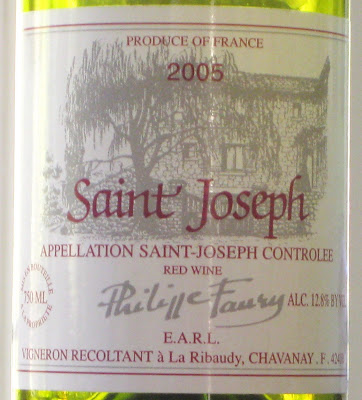
The next wine screamed northern rhone from the start. A good dose of black olive hit my nose as I sniffed the Phillipe Faury, Saint-Joseph, rouge, 2005. The wine was pure and elegant in the mouth. While traditionally styled, this wine was fruitier than the benchmark wines made by the great Raymond Trollat. It was a joy to drink a serious wine that weighed in at only 12.8% alcohol. I actually made it to the third quarter of the Hawaii game, which started at midnight!

Monday, October 13, 2008

Burgundy's great hidden treasure


Burgundy contains many hidden little treasures for the adventurous wine drinker, but all the big prizes have already been discovered. I believed this to be true until one day this past spring while on expedition in Burgundy. On March 19th, 2008, I was present when the wine equivalent of King Tut's tomb was unearthed. Our group had already tasted at six domaines and were on pace to be late for the seventh, but our French business associate insisted that we visit an estate in Givry. There are some nice wines made in Givry, but we had just tasted our way through Chassagne and Puligny, and the prospect of visiting a Chalonaise domaine was not very appealing. Our French colleague, however, proved very persuasive and we turned the car south towards Givry. We pulled into a small courtyard and within seconds were descending into an 18th century dungeon-like cellar. A white haired man wearing mostly black escorted us to a barrel labeled 'Givry blanc'. This mysterious figure had only been introduced to us as 'The Baron.' I stuck my weary nose into the glass and then took a swig. The wine was refreshingly mineral and crisp. A Givry rouge followed and I was taken aback by the beautiful structure the wine possessed. Firm tanins coated my mouth. I looked around the cellar and noticed several huge open top barrels lining the walls. The Baron announced that the next wine was Corton, Clos du Roi, and it proved to be a perfect expression of that vineyard. Next up, Les Grands Echezeaux. Wow! The Grand Echezeaux was spicy and very long on the finish. We followed the Baron to another stack of barrels. I rubbed my eyes to make sure my sight was not blurred from too much wine. 'Montrachet' was etched across the front of the casks. Bracing myself, I took my first ever sip of a wine from this mythical vineyard. The wine was golden in color, rich on the palate and full of liquid stones. It sat in my mouth and refused to leave.

"Is that really seven barrels of Montrachet?" I asked.

"Yes", our French associate replied. "The other 18 went to negociants."


The Bordeaux-Montrieux family has owned land in Givry since 1760, but for the past several decades their estate, Domaine Thenard, has sold most of its production to the negociant Maion Roland Remoissenet. While wine was released under the Thenard label at the domaine, Remoissenet requested that the wines not be exported to the U.S. market. In 2005, Remoissenet was sold to to a group of North American investors led by the Milstein brothers of New York and the Thenard estate decided to explore export options.


An interior view of the entrance to Domaine Thenard's cellar.


The estate was founded in 1842 by Baron Paul Thenard, who married a local girl with the last name of Bordeaux-Montrieux. In subsequent years, control of the domaine passed through the female side to the Bordeaux-Montrieux descendants. Despite being virtually unknown in the U.S., Domaine Thenard has been famous in Burgundy for over a century due to one monumental purchase. Two large parcels of Le Montrachet, totaling 1.86 hectares, were acquired by Baron Paul Thenard in 1872. Only the Marquis de Laguiche, with their single parcel of 2.06 hectares (Puligny side), own more land in this fabled vineyard. By comparison, the third largest owner in Montrachet is Bouchard Pere et Fils with 0.89 hectares. In the 20th century, the grand cru vineyards Clos du Roi in Corton and Les Grands Echezeaux in Flagey were added to the portfolio. These vineyard acquisitions made Thenard one of the most important estates in Burgundy, yet the heart of the domaine remained in the humble village of Givry.


Baron Jean-Baptiste Bordeaux-Montrieux


Baron Jean-Bapstiste Bordeaux-Montrieux has been in charge of the winemaking at the domaine since the earily 1980's, but most of the wine was sold to Remoissenet while still in barrel. The bottles sold under the Remoissenet label were not held in high esteem, but the cuvees purchased from Thenard stood out. In his description of Remoissenet, Clive Coates (The Wines of Burgundy, University of California Press, Berkeley, 2008) wrote, "the firm distributes the wines of Domaine Baron Thenard and these - Le Montrachet, Corton Clos du Roi, Grands Echezeaux - are often the best." Maison Entienne Sauzet also purchases the Montrachet in must form from Thenard and this is the sole source for their much sought after cuvee. Today, the Baron holds back the top cuvees for the estate and controls every step of the winemaking. The wines bottled under the Domaine Thernard label are serious vin de garde (wines to keep). I was blown away by a 1976 Givry rouge tasted at the domaine during our visit. Amazingly, the wine was still very much alive.


The open top tuns used for the fermentation of the Givry rouge.


The winemaking at Domaine Thenard is very tradtional and the wines have a firmness/rusticisty that reflect that style. The domaine's largest holding in Givry is in the premier cru Les Bois Cheveaux (7.66 ha), which tends to show slightly more power then the Givry premier cru Cellier Aux Moines (3.22 ha). Also in Givry is the premier cru Clos Saint-Pierre (2.12 ha). This vineyard, which is a monopole of the estate, produces the darkest colored and most ageworthy of the three Givry premier cru. In Pernand-Vergelesses, Thenard owns a piece of the finest vineyard in the village, Illes des Verglesses (0.85 ha). Right next door, on the hill of Corton, sits the domaine's prime parcel in the great Clos du Roi (0.9 ha ). The top section of Clos du Roi, where Thenard's vines are located, is considered superior to the lower portion of the vineyard and produces one of the more underated grand cru in Burgundy. Clive Coates considers Clos du Roi to be one of the very best vineyards in the Cote d'Or, on par with La Romanee Conti, La Tache, Chambertin and Le Musigny. Also included by Coates with those legendary names is Les Grands Echezeaux, of which Thenard is fortunate to own 0.54 hectares.

Three white wines are made at Domaine Thenard. The basic Givry blanc is fresh and bright. Far richer and more intense is the Chassagne-Montrachet, 1er Cru, Clos Saint-Jean (0.17 ha). The show stopper is, of course, the Le Montrachet (1.83 ha). In addition to owning a huge portion of this vineyard, the domaine is also blessed with old vines. The individual parcels were planted between 1931 and 1972. The resulting wine is deep in color and has an intense bouquet of white flowers and spicy oak. In the mouth, the wine is immense, but not heavy. A wave of minerals lurks in the background and keeps the wine from weighing down the palate. Thenard's Montrachet is truly a great wine.


Domaine Thenard owns two parcels in Le Montrachet, both of which can found on this map. Montrachet is divided in two by the Chassagne/Puligny border, which is represented by the dark line running through the vineyard on the right side of the map. The Chassagne half (3.99 ha) is known as 'Le Montrachet' and the Puligny side (4.01 ha) simply as 'Montrachet.' Domaine Romanee Conti owns the first parcel to the left of the Chassagne/Puligny dividing line (#31). Thenard owns the second, much larger plot (#32). The enormous parcel on the upper left hand side of the map (#34) also belongs to Thenard.


I left the domaine in a state of shock. Did I really just taste a Montrachet? Did I really suck down a '76 Givry that was still kicking? The next day, I awoke with a mild headache and descended down to the kitchen for a quick cup of coffee. Our schedule was packed and by 9am we were back in a cellar tasting, this time in Gevrey. A Chambertin-Clos-de-Beze was still fresh on my lips as our car zipped towards to Morey St-Denis, but I could not dislodge the Thenard visit from my mind. How could a cellar with 25 barrels of Montrachet resting inside, not to mention Clos du Roi and Grands Echezeaux, be hidden in total obscurity? I found myself zoning out at our next appointment as I pondered this question. Several reasons came to mind for Domaine Thenard's lack of fame, but none of them mattered now. Burgundy's great hidden treasure has been found--- in Givry of all places.

Thursday, October 2, 2008

#@$%&%$! on Le Chambertin


I guess birds do not have the same respect I do for Le Chambertin. Or, maybe they do not like Rossignol Trapet.

Wednesday, September 24, 2008

Tomato Pie Night - 9/24


Since the original Delorenzo's is now closed on Wednesday, I had to get the pies from the new location on route 33. While the pies are very similar, I feel that the ones made on Hudson Street are a little better. Louis Latour was once again the feartured producer and tonight we tried our first red from this large negociant. We started with a Chassagne-Montrachet, 1er Cru, Morgeot, 2006, which was really nice. The oak was moderate and and in the backgournd. The wine was rich, but very well balanced. Next up was a Bourgogne from a new producer in Morey-Saint-Denis. The Alain Jeanniard, Bourgogne, rouge, 2006 had a brightness and elegance that one expects in a wine sourced from Morey. Jeanniard, a star in the making, established his domaine in 2004 and still makes wine for the Hospices des Beaune. Lastly, we opened a Louis Latour, Beaune, 1er Cru, Perrieres, 2005. The color was deep and it showed ripe fruit on the palate. While enjoyable, the wine was pretty straight forward and not as exciting as the whites we have tasted from this producer.

Saturday, September 20, 2008

Champange Sunday - 9/21


Our 9th wedding anniversary was this weekend, so we opened a couple special bottles. First up, a Diebolt-Vallois, Champagne, Brut, a Cramant, 2002 that was very elgegant and pure. With time in the glass, the wine revealed a delicious touch of honey. This estate makes wonderful Champagnes and this bottle was terrific.

Next, a Domaine Georges Mugneret, Nuits-Saint-Georges, 1er Cru, Aux Chaignots, 2004 showed a light brick color. The wine was surprisingly expressive in the nose, but a slight green quality was present. Typical of the wines from this great domaine, this bottle was smooth and silky on the palate. On the negative side, the underripe fruit/green aspect that was revealed in the nose was also present in the mouth. I have had many 2004 red Burgundies that suffer this same problem, but I was hoping that this bottle might be the exception. Retailers are heavily discounting their 2004 red Burgundies and this makes them very tempting. Many of the wines, however, are flawed by green/underripe fruit. I have read reports from some Burgundy lovers that the green quality in the 2004's appears to be fading as the wines age in the bottle. In the name of science, I left one quarter of the bottle in the fridge overnight. I retasted the wine the next evening and it showed much better. The wine had gained weight and the ripe fruit flavors were more pronounced. The green quality had virtually disappeared. While some of the extremely green tasting wines will always be flawed, I have a feeling that best 2004's will be beautiful wines in 10 years.

Friday, September 19, 2008

A intimate dinner with the Burghound, well....sort of


When planning my trip to Beaune last July, I had visions of living out my own 'Sideways' experience. Instead of wandering down to the Hitching Post each evening (as Miles and Jack do), my wife and I would repeatedly settle in at the most well known wine bar in Beaune, Ma Cuisine. On any given night, the bistro run by Pierre Escoffier and wife Fabienne is full of wine professionals, winemakers and wine loving consumers. I imagined myself hobnobbing with famous winewriters, in particular, Allen Meadows, a.k.a the 'Burghound.' Why Meadows and not one of the other dozen well known critics who cover Burgundy? Well, probably because I knew what Mr. Meadows looked like and could picture the senario playing out in my mind. I had spoken with him face to face a couple years ago in Manhattan after he had led a tasting at the Burgundy Wine Company. Unlike your typical wine intellectual, the self appointed Burghound had a crew cut and appeared to have just gotten out of basic training. Before this encounter, I had thought all Burgundy experts spoke with a British accent and wore reading glasses.

The sun was setting when my wife and I were greeted by Monsieur Escoffier at the bistro's front door. He escorted us to the raised seating area at the back of the restaurant. The only other table in this area was filled by two men and a woman. The carte de vin was presented to me and the stressful challenge of selecting the perfect wine began. Actually, it was not that hard. I knew that I wanted to drink something from Coche-Dury and we started with the 2004 Bourgogne blanc. The nose revealed a subtle dose of spicy oak, but I have been told that disappears after some years in the bottle. In the mouth, the Coche was very elegant and pure. A beautiful wine.

As our first course was served, I heard a familiar voice directly behind me. My spine froze and a tingling sensation shot across my scalp. "Meadows is behind me," I whispered to my wife.
"How do you know," she replied, glancing over my shoulder.
"I recognize his voice."

A trip to the toilette was in order. I rose from my seat and shot a quick glance to my right. Never before had I seen the gentleman on the right, but across the table was a man who bore some resemblance to Meadows. As I washed my hands, I analyzed the person in question. Allen Meadows had that very distinctive crew cut when we met in New York. I had assumed that he had worn his hair that way since high school, but the man at the table had a full, typical male cut. Maybe my desire for a 'Sideways' moment was causing me to hallucinate. I opened the door and headed towards the rear of the packed restaurant. Half drunk bottles of Burgundy with familiar labels sat atop each table and Mr. Escoffier was busy pulling the corks out of several more. The three small steps that led to the raised seating area suddenly seemed insurmountable. I felt like Rocky as he looked up at the stairs leading to the Philadelphia Art Museum . The gentleman turned towards me as I reached the top and our eyes locked. Time froze. A look of puzzlement washed over his face.

"Mr. Meadows, I met you last summer at......"

The gentleman acknowledged that I looked familiar and we began a slow dance of small talk. Indeed, this man was the 'Burghound'. I spent the next hour and a half trying not to embarrass myself, which became more difficult as we consumed our second bottle (a terrific 2000 Henri Gouges, Nuits-St.-Georges, 1er Cru, Les St-Georges). The hardest part about meeting someone you admire is acting like the encounter is no big deal. Combine that task with alcohol consumption and you had better have an Oscar under your belt. After washing down the last of the Gouges, my wife and I said goodbye and wandered back to the hotel. The 'Burghound' and I may never again meet face to face, but at least we will always have Beaune.

Wednesday, September 17, 2008

The six rules

The wine business sounds very glamorous, but it is riddled with pitfalls. Industry tastings can be exhausting, but there is a sense of order that keeps them from getting really out of control. The same goes for winemaker dinners. Company parties on the other hand, can be life threatening. Typically at these events, several great bottles of wine are thrown down on the table and everyone scrambles to get a taste. No drinking related issues would prbably arrise if the number of bottles were limited to, say, one per person. In reality, however, the ratio is closer to 2 bottles per. I always feel bad for the new hire who is confronted with all this great wine for the first time. Inevitably, these rookies dive right in and often they have to be pulled out just before drowning. Here are six rules that can help one survive a wine industry party.

1- Arrive late and leave early
It is a good idea to reduce the window of time that you are obligated to drink.

2- Drink only one half glass of Champagne
I love Champagne, but it goes down the hatch way too fast. In addition, the bubbles in Champagne speed up the transfer of alcohol into your blood stream. If, God forbid, you are talked into a second glass, immediately arrange for an ambulance to pick you up later.

3- Stick to German Riesling and red Burgundy
The lower the alcohol, the better.

4- Consume a ton of water
I always feel like I should have a drink in my hand at these functions and rotating in several glasses of water is a smart move.

5- Never go out for the post party drink
One last drink always turns into three. If you do decide to go out, make sure that you have an extra bagel in the house. Mr. Hangover will be paying a visit the next morning.

6- Find someone to ride the train with you on the way home
If you are not able to find a train buddy, you run the risk of falling asleep and ending up in a run down city with a high murder rate.

The David Bowler Wine 5th anniversity party is beging held this evening in New York City and I am going to glue these rules to my forehead.